

Chartres Cathedral: A Complete Guide to France's Greatest Gothic Monument
Eighty kilometers southwest of Paris, Notre-Dame de Chartres rises from the flat Beauce plain with a certainty that has unsettled travelers for eight hundred years — its asymmetric towers visible from twenty-five kilometers in every direction. This guide draws on a licensed guide's sustained engagement with both Chartres and Notre-Dame de Paris to give you what no aggregator site does: the architectural logic, the iconographic depth, the history that shaped France, and the honest visitor intelligence you need to experience it fully.
Private guided tours of Chartres Cathedral can be arranged — contact us directly. If you stay in Paris, and do not have plan to visit Chartes remember to watch our Paris Notre-Dame Cathedral Private Tour page.
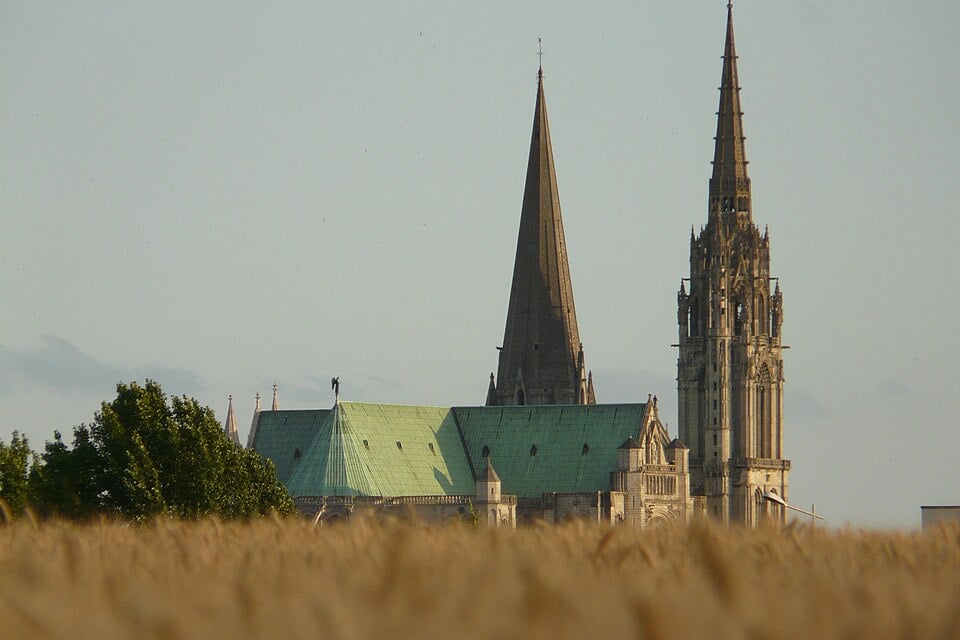
The cathedral's silhouette, visible for more than 25 km across the Beauce wheat plain, has functioned as a landmark for pilgrims since the 12th century. The taller Flamboyant north spire (left, 113 m) was added by Jean Texier between 1507 and 1513; the austere Romanesque south tower (right, 105 m) predates the fire of 1194. Credit Pauden28 CC BY-SA 3.0
A Cathedral Born from Disaster: The History of Chartres Cathedral
At least five cathedrals have occupied the hill of Chartres, each replacing a predecessor destroyed by fire or conflict. The earliest Christian structure on the site dates to the 4th century. In 743, it was burned on the orders of the Duke of Aquitaine. In 858, Danish raiders destroyed its successor. In 1020, fire devastated the Romanesque basilica built under Bishop Fulbert, who began again immediately on a larger scale — the vast crypt he constructed still underlies the entire building today. A further fire struck in 1134. Then, on the night of June 10–11, 1194, lightning struck the roof and a catastrophic fire consumed everything above ground except the two west towers, the Portail Royal, and the underground crypt.[2]
The people of Chartres despaired — not only at the loss of the building, but at the apparent fate of the city's most sacred possession: the Sancta Camisia, the tunic said to have been worn by the Virgin Mary. Three days after the fire, priests emerged from the underground crypt carrying the relic intact. A papal legate present in the city interpreted this as a sign: the Virgin wished a more magnificent house. What followed was one of the most concentrated building campaigns in the history of Gothic architecture. Within approximately twenty-five years — an astonishing pace for a building of this scale — the new cathedral was essentially complete, its nave, choir, transepts, three great porches, and the overwhelming majority of its stained glass in place.[2] The building was formally consecrated in 1260 in the presence of King Louis IX, later canonized as Saint Louis.
Because it was raised in a single coherent campaign rather than across multiple generations, Chartres possesses a unity of design unmatched by any other Gothic cathedral. UNESCO, designating it a World Heritage Site in 1979, called it "the high point of French Gothic art" — a building whose architecture, sculpture, and stained glass constitute, in the committee's assessment, "the complete and perfected expression" of medieval art at its height.[3]
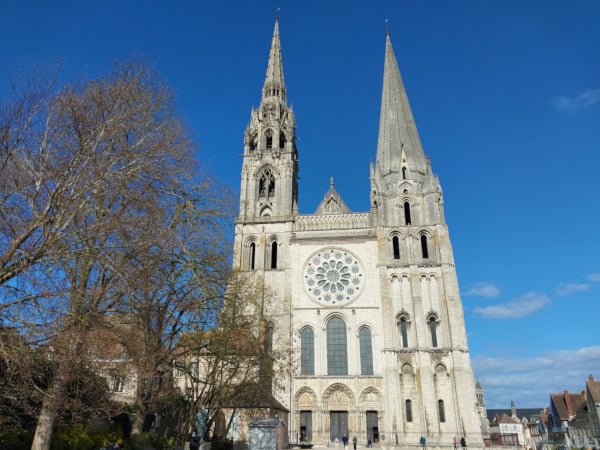
The west façade of Chartres Cathedral: three and a half centuries of Gothic architectural history condensed into a single composition. The south tower (right) dates from c.1160; the north spire (left) from 1513.
The Structural Revolution: How Chartres Changed Gothic Architecture
Before Chartres, Gothic cathedrals — including the early stages of Notre-Dame de Paris, already under construction when Chartres burned — typically organized their interior elevation in four stories: a ground-level arcade, a wide gallery above it (the tribune), a narrow triforium, and a modest clerestory at the top. The tribune was structurally necessary: its mass helped counteract the lateral thrust of the heavy stone vaults above. Light, in consequence, was scarce.
The builders of the 1194 campaign solved this problem fundamentally differently. By deploying flying buttresses as the primary system for transferring vault thrust to exterior pier buttresses — rather than relying on gallery mass — they eliminated the tribune entirely. In its place: a deliberately narrow triforium, barely more than a decorative blind arcade, and above it a greatly expanded clerestory of enormous windows constituting almost the full height of the upper wall. For the first time in a building of this scale, the wall above the arcade was mostly glass.[4]
The vaults themselves were redesigned. Where earlier Gothic buildings used six-part vaults — each bay divided into six compartments — Chartres used four-part vaults, lighter and spanning greater distances. The compound piers alternate in cross-section between round and octagonal, creating a rhythmic pulse that draws the eye eastward toward the choir. The nave rises to 37 meters — a record at the time. The structural logic is legible from floor to keystone: weight from each vault transfers cleanly through the ribs to the piers below. The architecture does not just contain space; it explains itself.
This solution — three-level elevation, four-part vault, flying buttress as primary structural mechanism — was adopted almost immediately at Reims, Amiens, and Beauvais, and through those buildings influenced Westminster, Cologne, and León. Chartres is the source text of the mature Gothic tradition.
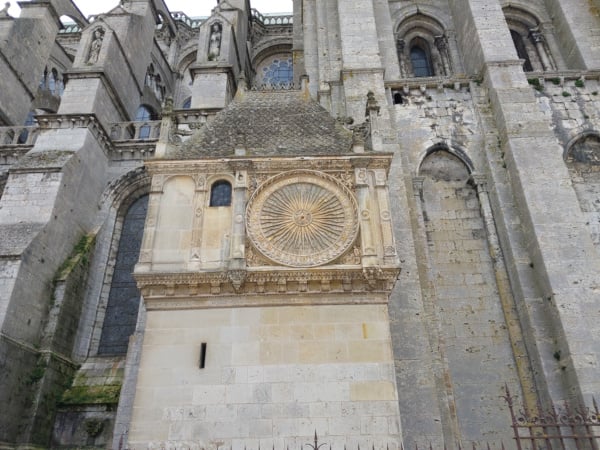
The flying buttresses: the structural invention that permanently changed Gothic architecture. By carrying vault thrust to freestanding exterior piers, they freed the upper walls from load-bearing duty — and filled them with glass.
The Royal Portal: Where Gothic Sculpture Was Born
The Portail Royal predates the rest of the cathedral by half a century. Carved around 1145–1155 and spared by the 1194 fire, it was absorbed into the new building as a founding element — the crypt and the west facade together determined the dimensions of everything built after. Standing before these three doorways is the experience of being present at the birth of Gothic sculpture.
The iconographic program is encyclopedic and rigorously structured. Read the three tympana as a theological argument unfolding from south, then north, and finally center.
- South (right) portal: The Incarnation — the Virgin enthroned with the Christ Child in the Sedes Sapientiae (Throne of Wisdom) iconography, with Annunciation, Visitation, and Nativity on the lintel. The archivolts contain the Seven Liberal Arts with their canonical ancient practitioners: Aristotle (Dialectic), Pythagoras (Music), Euclid (Geometry).
- North (left) portal: The Ascension — Christ borne on a cloud by angels, with the signs of the Zodiac and Labors of the Months in the archivolts: the temporal world ordered beneath the divine.
- Central portal: The culmination — Christ in Majesty enthroned in a mandorla, holding the Gospels, surrounded by the symbols of the four Evangelists. The outer archivolt carries the twenty-four Elders of the Apocalypse. This is the Second Coming as the telos of the entire program.
The column statues flanking all three portals — kings and queens of the Old Testament — are what art historians mean when they describe the Royal Portal as epoch-making. Their bodies are elongated to integrate with the columns, but their faces are individual, alive with what the architectural historian John James called "a delicate modulation of anatomy and expressions verging on smiles."[10] Compared to the frozen Romanesque figures at Moissac or Vézelay, these are not ornamental decoration. They are the beginning of something.
Spend serious time here before entering the cathedral. Most visitors move inside immediately. The portal rewards sequential, guided reading — the kind of sustained attention that transforms a visual experience into an intellectual one.
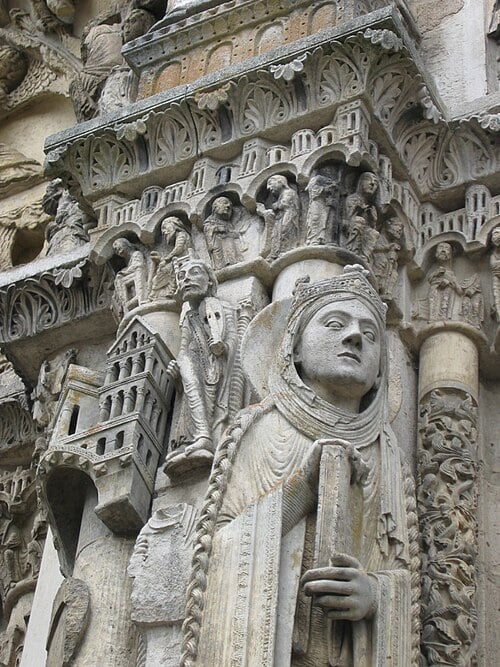
The Portail Royal (c. 1145–1155): the oldest surviving Gothic sculptural ensemble, and the first French portal in which column figures are rendered with individual expressions. It makes the transition from Romanesque to Gothic. It is an exceptional Early Gothic masterpiece. It predates the 1194 fire and set the standard for every major cathedral porch that followed.
167 Windows: The Glass That Defines the Building
Chartres holds the largest surviving collection of medieval stained glass in the world: 167 windows covering approximately 2,500 m², with more than 3,500 individual figures.[1] Of these, a substantial portion dates from the first quarter of the 13th century, executed within a compressed twenty-to-thirty-year workshop campaign that gives the ensemble its unusual chromatic coherence. This is not a collection assembled across centuries; it is a single sustained vision.
The West Lancets and the Chartres Blue
The three tall lancet windows beneath the west rose window are the oldest glass in the building, dating from around 1150 — they predate the fire and were carefully preserved in the rebuilt structure. The Jesse Window (right) traces Christ's genealogy through a flowering Tree of Jesse; the central window depicts the Life of Christ; the left, the Passion and Resurrection. They are among the oldest complete narrative stained glass compositions surviving anywhere in Europe.
These windows are the defining example of what art historians and glass-makers call le bleu de Chartres: a lighter, distinctly sky-toned blue achieved through a combination of cobalt oxide and manganese with a translucency that later workshops never exactly replicated. The later 13th-century glass elsewhere in the building uses a deeper, more saturated sapphire blue balanced by striking reds and ochres, producing a denser, more jeweled light. Both are visible simultaneously in the building, and the contrast between them is one of the subtler pleasures of a sustained visit.
The Blue Virgin (Notre-Dame de la Belle-Verrière)
The single window most consistently cited by glass specialists is the Notre-Dame de la Belle-Verrière in the south choir aisle. The central panel — the Virgin enthroned with the Christ Child, surrounded by seraphim — dates from around 1180, making it pre-fire and among the oldest glass on the site. The surrounding border panels were added after 1194. The juxtaposition of 12th-century blue against 13th-century additions is visible to the attentive eye and speaks directly to the layered history of the building.
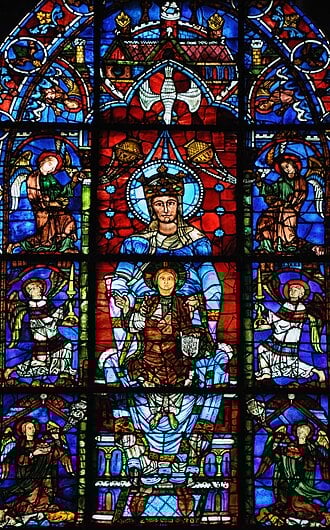
The Notre-Dame de la Belle-Verrière (c. 1180), south choir aisle: the oldest surviving glass panel in the cathedral. The central medallion predates the 1194 fire; the surrounding angels and border were added in the 13th century. The chromatic difference between the two campaigns is perceptible in person.
The Three Rose Windows
Chartres has three rose windows, each a distinct theological proposition:
- West rose (c. 1215): The Last Judgment. Christ presides at the center; the saved and the damned radiate outward. This is the last image a visitor sees on departure — deliberately so.
- North rose (c. 1235): Dedicated to the Virgin and the Old Testament. Donated by Blanche of Castile, mother of Louis IX; her fleurs-de-lis and the castles of Castile appear in the lancets below.
- South rose (c. 1221): The Glorified Christ enthroned, encircled by angels, evangelists, and elders. Donated by the Count of Dreux; his coat of arms appears in the lancets below.
A detail worth noting: if you project the west facade onto the nave floor, the center of the west rose window aligns with the center of the labyrinth. The same Christ presides over the beginning and end of the pilgrim's journey through the building. This is not coincidence.
The Sancta Camisia: The Relic That Built a Cathedral
Chartres is, liturgically, a pilgrimage church. Its primary relic is the Sancta Camisia — a tunic said to have been worn by the Virgin Mary at the birth of Christ, donated to Chartres around 876 by the Carolingian king Charles the Bald.[8] Its arrival transformed a provincial episcopal town into one of the great Marian pilgrimage destinations of medieval Europe, drawing kings, crusaders, and common pilgrims in numbers that necessitated a cathedral of extraordinary scale.
Its survival of the 1194 fire — carried intact from the burning building to the underground crypt — was interpreted by contemporaries as direct divine intervention, and it was this interpretation, more than any other single factor, that motivated the speed and ambition of the subsequent rebuilding campaign. The relic remains at Chartres today, displayed in the Chapel of the Holy Veil in the north ambulatory.
The Labyrinth: The Road to Jerusalem?
The labyrinth, inlaid in the nave floor around 1200 in blue-grey limestone, is 12.9 meters in diameter — almost exactly the diameter of the west rose window above it. It consists of a single, unbranching path of 294 meters that winds eleven circuits to reach the center. You will often read that Medieval pilgrims walked it on their knees as a substitute for the pilgrimage to Jerusalem; and that the center, sometimes called Jérusalem, was the destination.
I disagree; for me it is a journey to Jesus, "Light of the World", as the labyrinth is oriented as the cathedral to the northeast, the direction of the summer solstice. Indeed, if you translate the facade down to the floor of the cathedral, the center of the western rose, where Jesus is represented, will coincide with the center of the labyrinth.
The substitute for pilgrimage to Jerusalem is the stations of the cross. A concept that was first developed for Catholicism by the Franciscans in the 13th century in the Holy Land, in the exact place of the passion of Jesus. But it was only on September 5, 1686, that Pope Innocent XI authorized the Franciscans to implement stations of the cross in their churches, and then in 1781 that Pope Clement XII authorized their implementation in any churches.
Today, the labyrinth it is used for contemplative walking by pilgrims, scholars, and visitors of no particular faith who nonetheless find it arresting.
A practical note that most travel websites get wrong: the labyrinth is covered by chairs for the majority of the week and is accessible for walking only on Fridays, from 10:30 a.m. to 4:45 p.m., starting on the first Friday of Lent and ending on the last Friday before All Saints' Day — in 2025, from March 7 to October 31, excluding Good Friday (April 18).[13] Outside those times, it is covered and invisible. If walking the labyrinth is part of your reason for visiting, plan around this schedule.
Henry IV and the Coronation of 1594
Chartres Cathedral holds a singular place in French political history that almost no travel guide acknowledges: on February 27, 1594, it was the site of the only royal coronation ever to take place outside Reims.
The circumstances were the climax of the Wars of Religion. Henry of Navarre, heir to the French throne, had converted from Protestantism to Catholicism in July 1593 — the conversion that gave posterity the apocryphal remark "Paris vaut bien une messe" (Paris is well worth a mass). The traditional coronation cathedral at Reims was held by the Catholic League, which refused to recognize him. Chartres, firmly in royalist hands, was the alternative. The ceremony was performed by the Archbishop of Bourges before an assembly of the realm; within weeks Henry entered Paris in triumph, and the Wars of Religion were, for practical purposes, over.
The choice of Chartres was not incidental. The cathedral's status as the premier Marian shrine in France, and the symbolic weight of the Sancta Camisia in its treasury, gave the ceremony a legitimacy it could not have drawn from a lesser building. Henry needed the Virgin's house as much as he needed the Archbishop's consecration.
For an American audience already familiar with Henry IV — the Edict of Nantes, the reconstruction of France after the religious wars, the poule au pot — this is the moment that connects Chartres to the larger political history of the country. It belongs in any serious account of the cathedral.
A World War II Miracle: How the Glass Survived
In September 1939, as the German invasion of France became a credible prospect, a systematic operation began at Chartres under the direction of canon Yves Delaporte. Every one of the cathedral's medieval stained glass panels — thousands of individual pieces of glass, many of them fragile, 12th- and 13th-century originals — was methodically removed from its leading, catalogued, and transported to safe storage across the region. The operation took weeks and required scaffolding throughout the building.
When the German army occupied France in June 1940, Chartres Cathedral stood with empty windows. The glass had been dispersed to undisclosed rural locations. It survived the occupation intact. After the Liberation, it was transported back to Chartres, and in a restoration effort that itself took years, every panel was reinstalled in its original position.[11]
There is a separate near-miss in the American story of Chartres. On August 15, 1944, during the Allied advance toward Paris, an American officer named Colonel Welborn Barton Griffith Jr. volunteered alone to enter the town under fire and verify whether German troops were using the cathedral towers as observation posts. He confirmed they were not. The order to shell the towers was cancelled. Griffith was killed in combat the following day. He is buried in the Normandy American Cemetery at Colleville-sur-Mer. A plaque commemorating him is displayed inside the cathedral.[11]
Both stories — Delaporte's methodical foresight and Griffith's single act of courage — are the reason you can stand inside Chartres today and see what 13th-century glaziers made. They deserve to be told.

German Parade In Paris a symbol of the occupation of France by Nazie Germany.
.
The Restoration Debate: What You Will Actually See Today
Since 2009, the French Ministry of Culture has overseen an approximately €18 million restoration of the cathedral's interior under chief architect Frédéric Didier. The stained glass windows have been cleaned — a process universally praised — and the interior walls, vaults, and piers have been repainted in light ochre with false-masonry joints in white, an attempt to recreate the documented 13th-century decorative scheme.[6]
The restoration triggered genuine controversy. The American architectural critic Martin Filler, writing in The New York Review of Books, described it as a desecration and argued that the bright painted surfaces diminished the stained glass — whose chromatic depth had long been enhanced, for generations of visitors, by contrast with a dark, soot-blackened interior. Architectural Record called the project misguided. A petition circulated citing violations of the 1964 Venice Charter.
The counterargument, made by art historians Jeffrey Hamburger and Madeline Caviness and supported by extensive archaeological sampling going back to research by the German scholar Jürgen Michler in the 1980s, is that the ochre-and-white scheme is historically documented with high confidence: approximately 80% of the interior surface retained traces of 13th-century decoration. What critics experienced as dark, eternal stone was centuries of candle soot, incense residue, and oil-furnace grime. The restoration team was not inventing a medieval aesthetic; it was uncovering one.[7]
Both sides are partly right. The cleaned glass is transformative — you can now read iconographic detail in the upper clerestory windows that was invisible under grime, and the difference in the lancet blues alone justifies the project. The painted walls are more jarring, partly because the restored surfaces contrast sharply against the original stone floor, worn smooth by centuries of pilgrims, which now reads as conspicuously unrestored. The cathedral today looks newer than it feels. Come prepared to form your own judgment — and to have it informed, if you visit with a guide, by someone who knew the interior before and after.
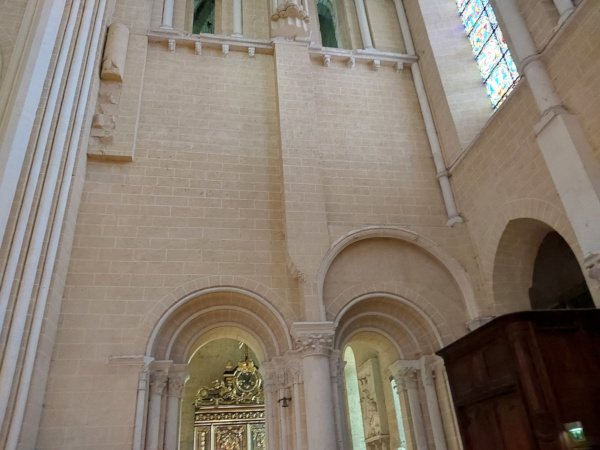
The post-2009 interior: ochre walls with white false-masonry joints, based on 13th-century decorative evidence. The restored stained glass — cleaned for the first time in generations — now reads with a clarity previously impossible. Whether the overall effect honors or diminishes the building remains a live debate.
Chartres and Notre-Dame de Paris: Two Sisters, One Bloodline
The two buildings are best understood as consecutive chapters in the same story. Notre-Dame de Paris was already under construction when the 1194 fire destroyed Chartres — its original four-story elevation reflects the structural thinking the Chartres builders then decisively superseded. The subsequent modifications to Notre-Dame de Paris, particularly the enlargement of the clerestory windows in the 13th century, are a direct response to what had been achieved at Chartres. The influence ran one way: Chartres set the terms, and Paris answered them.
What each building offers the other's visitor is clarity. Notre-Dame de Paris sits at the center of one of the world's great cities and carries the full weight of that urban history — the coronation of Napoleon, the 2019 fire, the December 2024 reopening. Its complexity is political and cultural as much as architectural. Chartres rises in isolation above a provincial town, which makes its structural logic more immediately legible: there is nothing to read but the building. Visiting Chartres first gives you the vocabulary; a private guided tour of Notre-Dame de Paris gives you the sentence.
For the serious traveler, seeing one without the other is to see only half the story.

Notre-Dam Cathedral Paris.
Planning Your Visit
Getting There from Paris
Chartres is served directly from Paris Gare Montparnasse by SNCF Transilien line N, with journey times of approximately 70 to 75 minutes on direct services. Trains run roughly hourly throughout the day. From Chartres station, the cathedral is a ten-minute walk uphill through the old town — the towers are visible from the platform as you arrive.[12]
Opening Hours and Admission
Entry to the cathedral is free. The building is open daily from 8:30 a.m. to 7:30 p.m. year-round (last entry 7:15 p.m.), with late-night openings to 10:00 p.m. on Tuesday, Friday, and Sunday evenings in July and August during the Soirées Autrement event program. Visitors may not circulate during masses and major religious celebrations — check the cathedral's calendar before visiting.[12]
What Requires a Separate Ticket or Guided Tour
- North tower (113 m): Accessible by guided tour only. The view across the Beauce plain and along the cathedral's flying buttresses is architecturally instructive. Check current schedules at the information desk.
- Crypt: Guided tour, departing from the south entrance (fee applies). The crypte Saint-Fulbert — 230 meters long, one of the largest in Europe — contains the Puits des Saints-Forts, a 33-meter well of possible pre-Christian origin, and the Chapel of Our Lady of the Crypt.
- Labyrinth: Free, but walkable only on Fridays from 10:30 to 16:45, March to late October (2025: March 7–October 31, excluding Good Friday, April 18).
Guided Tours in English
Private guided tours in English are available year-round through the Cathedral Rectory. The cathedral's accredited guides are successors to the legendary Malcolm Miller, who guided at Chartres for more than sixty years and remains the author of the standard English-language reference work on the building. Public English-language tours run from May to late September, Tuesday through Saturday. Groups of ten or more are required to use an audioguide system under the cathedral's rules for maintaining a meditative atmosphere.[14]
Practical Notes
- Luggage is not permitted inside the cathedral under the Vigipirate security plan. It may be deposited at the Rectorate, 16 Cloître Notre-Dame.
- Photography for personal use is permitted throughout.
- Appropriate attire is required; no beach wear or hats for men inside the building.
- A wheelchair ramp is located to the right of the west portal; a wheelchair is available on request.
- Allow a minimum of 90 minutes for a serious self-guided interior visit. A private guided tour covering the portal, the glass, the labyrinth, the crypt, and the towers runs five to six hours. Do not combine Chartres with other Paris-area monuments on the same day.
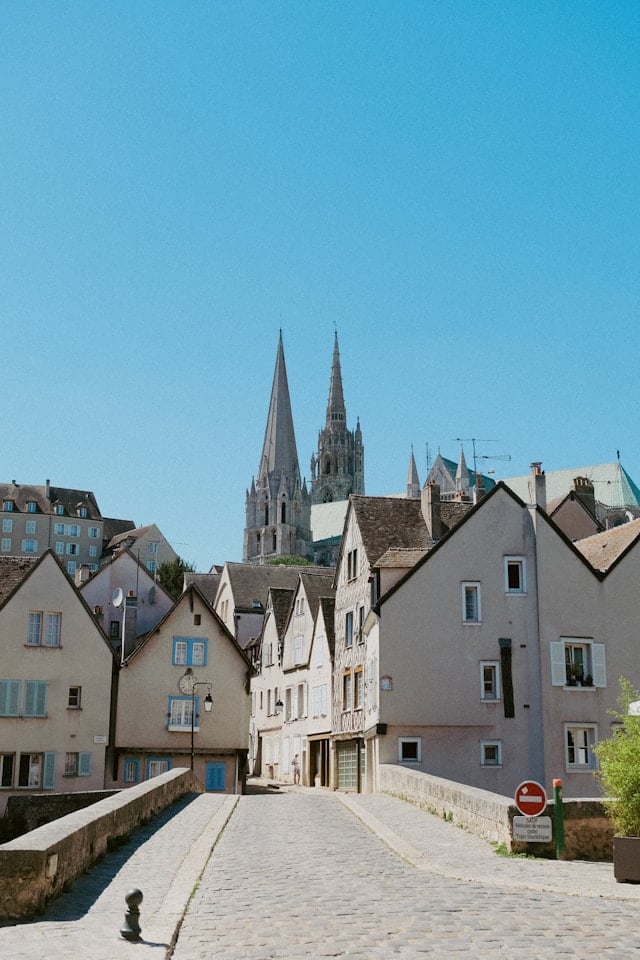
The cathedral from the Eure river quarter: allow time beyond the building itself to explore the medieval streets of the lower town, one of the most atmospheric and undervisited historic districts within easy reach of Paris.
Frequently Asked Questions
Is Chartres Cathedral worth visiting from Paris?
Yes — unambiguously. Chartres is not a day-trip supplement to Paris; it is a primary destination in its own right. The cathedral's near-complete 13th-century stained glass, the Royal Portal's sculptural program, the architectural coherence of its Gothic interior, and its pivotal role in French political history place it among the handful of monuments in France with genuine, irreplaceable weight. Allow a full day. The train from Paris Gare Montparnasse takes approximately 70 to 75 minutes on direct services.
How is Chartres Cathedral different from Notre-Dame de Paris?
The two buildings are complementary chapters in the same story. Chartres, rebuilt mainly between 1194 and 1220, is the structural prototype — the building where the flying buttress was first deployed at full scale to eliminate the tribune gallery and expand the clerestory, establishing the three-level Gothic elevation that Notre-Dame de Paris refined and elaborated. Chartres has also preserved its medieval stained glass almost intact, which Notre-Dame largely lost through 18th-century alterations. Notre-Dame carries the weight of Parisian political and cultural history; Chartres rises in provincial isolation, which makes its structural logic more immediately legible. Understanding Chartres is the best possible preparation for understanding Notre-Dame de Paris.
How many stained glass windows does Chartres Cathedral have?
Chartres Cathedral has 167 windows covering approximately 2,500 m² — the largest surviving collection of medieval stained glass in the world, with the vast majority intact from the 12th and 13th centuries. This figure comes from the cathedral's official documentation; some secondary sources cite 176, a discrepancy likely reflecting different counting methods for rose oculi and subsidiary lights.
Can you walk the labyrinth at Chartres Cathedral?
Yes, but only on specific days. The labyrinth is covered by chairs for the majority of the week and accessible for walking only on Fridays, from 10:30 a.m. to 4:45 p.m., between early March and late October each year (in 2025: March 7 to October 31, excluding Good Friday, April 18). The walk is free. The labyrinth remains visible when covered — its full 12.9-meter diameter can be traced from the nave on any day.
Was Henry IV really crowned at Chartres?
Yes. On February 27, 1594, Henry IV was consecrated King of France at Chartres Cathedral in the only French royal coronation ever to take place outside Reims. The traditional coronation cathedral was held by the Catholic League, which refused to recognize Henry despite his conversion from Protestantism the previous year. Chartres, held by royalist forces, was chosen both for practical and symbolic reasons: as the premier Marian pilgrimage shrine in France, it lent the ceremony the legitimacy that Reims could not provide. Henry entered Paris in triumph the following month.
What is "Chartres blue" and why is it famous?
Le bleu de Chartres refers to the distinctive sky-toned, translucent blue of the oldest stained glass in the building — particularly the three lancet windows beneath the west rose window, dating from around 1150. It was produced through a specific combination of cobalt oxide and manganese that later workshops never exactly replicated. It differs perceptibly from the deeper, more saturated sapphire blue of the 13th-century glass installed after the 1194 fire. Both are visible in the building today, and the contrast between them is one of the most instructive comparisons available to anyone interested in the history of medieval glass.
How did Chartres Cathedral's stained glass survive World War II?
In September 1939, canon Yves Delaporte organized the systematic removal of every medieval stained glass panel from the cathedral — thousands of individual pieces, catalogued and dispersed to safe storage locations across the region before the German invasion. The cathedral stood with empty windows throughout the occupation. After the Liberation, the panels were transported back to Chartres and painstakingly reinstalled. Separately, in August 1944, an American officer — Colonel Welborn Barton Griffith Jr. — entered the town under fire to verify that German forces were not using the cathedral towers as observation posts, allowing the order to shell them to be cancelled. Griffith was killed in action the following day and is buried at the Normandy American Cemetery.
Why do the two towers of Chartres Cathedral look so different?
They were built three and a half centuries apart. The south tower's Romanesque base dates from around 1144 and survived the 1194 fire; its plain pyramid spire rises to 105 meters. The north tower base is also 12th-century, but its spire — the taller at 113 meters — was added in Flamboyant Gothic style between 1507 and 1513 by the master builder Jean Texier, after the original north spire was destroyed by lightning. The resulting asymmetry became one of the most recognizable silhouettes in French architecture.
Conclusion
What strikes me most, after many visits with clients over the years, is not any single element of Chartres taken in isolation — not the glass, not the portal, not the labyrinth — but the sense that everything was resolved together. The structural logic of the flying buttresses, the three-level elevation, the program of the glass, the iconography of the portals, the pilgrimage function of the relic: these are not accumulated over time. They form a single sustained intellectual and spiritual proposition, executed at speed and with full confidence by a generation that believed it was building for eternity. The evidence suggests they were right.
Chartres is also, as this guide has tried to show, more than a medieval monument. It is the building where Gothic architecture found its mature language; the cathedral that stood firm through the Wars of Religion and lent its authority to the coronation that ended them; the building whose glass was saved, piece by piece, from two world wars by acts of foresight and courage that deserve to be better known.
For those planning a visit to Paris, Chartres is a one-hour train ride from Gare Montparnasse and one of the most rewarding days in France. And for those who want to understand what they are looking at when they stand before Notre-Dame de Paris — its proportions, its structural logic, its place in the history of Gothic architecture — a day at Chartres is the best possible preparation.
To take the Gothic story further: My private guided tours of Notre-Dame de Paris cover the cathedral's architecture from its debt to Chartres through its medieval and modern history, the 2019 fire, and the December 2024 reopening — with the expertise of a licensed guide-conférencier who knows both monuments.
References and Ressources
References
- Cathédrale de Chartres. The Stained Glass Windows. Official website of Notre-Dame de Chartres. cathedrale-chartres.org
- Cathédrale de Chartres. The 13th Century Cathedral. Official website of Notre-Dame de Chartres. cathedrale-chartres.org
- UNESCO World Heritage Centre. Cathedral of Chartres (Ref. 81). Nomination dossier and evaluation. whc.unesco.org
- American Friends of Chartres. Architecture: The Gothic Elevation. friendsofchartres.org
- American Friends of Chartres. Architecture: The Crypt. friendsofchartres.org
- Hamburger, Jeffrey F. and Caviness, Madeline. "Does the restoration of Chartres Cathedral deserve praise?" Apollo Magazine. apollo-magazine.com
- Archpaper / The Architect's Newspaper. "Why critics are skeptical of renovations bringing eternal youth to Chartres Cathedral," November 2015. archpaper.com
- Goppion. Cathédrale Notre-Dame de Chartres — Vitrine du voile de la Vierge. goppion.com
- Chartres Labyrinth Tours. The Labyrinth. chartreslabyrinthtours.com
- James, John. The Contractors of Chartres. Dooralong, Australia: Mandorla Publications, 1979.
- Borges' Library. The Miracle of Chartres Cathedral. February 2018. borges-library.com
- Cathédrale de Chartres. Opening Hours. Official website. cathedrale-chartres.org
- Cathédrale de Chartres. The Labyrinth. Official website. cathedrale-chartres.org
- American Friends of Chartres. Visit — Guided Tours. friendsofchartres.org
- Von Simson, Otto. The Gothic Cathedral: Origins of Gothic Architecture and the Medieval Concept of Order. Princeton University Press, 1956.
- Viollet-le-Duc, Eugène. Dictionnaire raisonné de l'architecture française du XIe au XVIe siècle. Paris, 1854–1868.
Ressources
- Royal portal description in detail (video in French)
- 360° panoramic views of the Chartres Cathedral by Andrew TALLON, Associate Professor of Art at Vassar College, New York (died in 2018)
- Chartres Cathedral architecture, Association Art et Histoire (video in French)