

Best Restaurants Near Notre-Dame Cathedral Paris: An Insider's Selection
Notre-Dame's December 2024 reopening returned an extraordinary neighborhood to the world's attention — one that, long dismissed as a tourist trap, has quietly become home to one of the highest concentrations of Michelin-starred restaurants in the city. As a licensed Paris guide who has led private tours through these streets for years, I've eaten, tested, and revisited every address below. This is not a compiled list; it is a considered selection.
Broaden Horizons can organize private tours in the chartres Cathedral, contact us by email. If you stay in Paris, and do not have plan to visit Chartes remember to watch our Paris Notre-Dame Cathedral Private Tour page.
Table of Contents
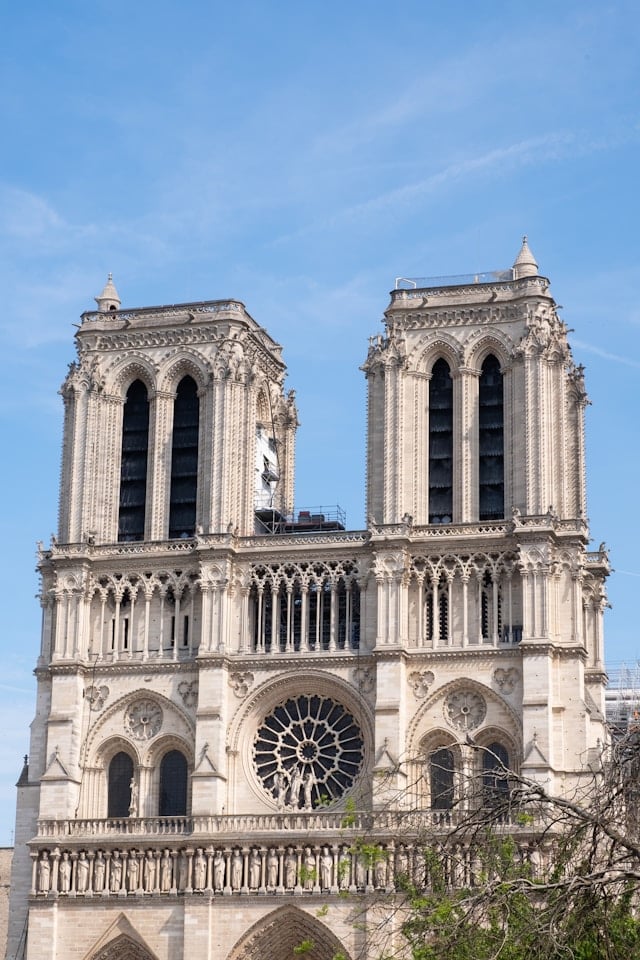
The World famous Notre-Dame Cathedral's facade.
Understanding the Neighborhood
The area surrounding Notre-Dame de Paris spans three distinct micro-neighborhoods, each with its own dining identity. The two Seine islands — Île de la Cité (where the cathedral stands) and Île Saint-Louis (immediately to the east) — offer the most intimate, historic atmosphere, but few tables of genuine gastronomic ambition. Cross onto the Left Bank and you enter the 5th arrondissement, specifically the stretch between the quais and the Place Maubert: this is where the neighborhood earns its culinary reputation, with a cluster of Michelin-starred restaurants within a ten-minute walk of the cathedral's south portal. A short detour into the 6th arrondissement (Saint-Germain-des-Prés) broadens the options further, without adding more than fifteen minutes on foot.
Since Notre-Dame's reopening in December 2024, foot traffic in this zone has surged dramatically. Restaurants that had quietly settled into a loyal, local clientele are now facing reservation requests from visitors worldwide. The practical consequence: book earlier than you think necessary, and read the reservation guidance at the end of this post before you plan your itinerary.

The two islands of Paris — Île de la Cité and Île Saint-Louis — seen from above. The cathedral's neighborhood is also one of the city's most rewarding dining destinations.
The Great Dinner: Iconic Tables with a View of Notre-Dame
A handful of restaurants in this neighborhood belong to a rare category: they deliver serious food and have a direct, unobstructed view of Notre-Dame's towers or a panorama of the Seine that places the cathedral in its full Parisian context. These are destinations in their own right — plan your visit around them, not as an afterthought.
La Tour d'Argent
15 Quai de la Tournelle, 5th arrondissement — One Michelin Star
No restaurant in Paris pairs gastronomy with a cathedral view more dramatically than La Tour d'Argent. Seated on the sixth floor, your table looks directly across the Seine toward the apse and flying buttresses of Notre-Dame — a perspective that most visitors, standing at street level, never see. The view alone would justify a visit; the food makes it obligatory.
Chef Yannick Franques, a Meilleur Ouvrier de France, anchors the menu in classical French technique while pulling personal threads from his years cooking in Provence. The signature pressed duck — canard à la presse, numbered since the tradition began in the 1890s — remains the theatrical centerpiece, finished tableside from a silver press that looks like a prop from a Jules Verne novel. The wine cellar, with over 300,000 references, is among the most comprehensive in France.
The four-course lunch menu is priced at approximately €160 per person and represents the most accessible entry point. Dinner climbs substantially higher. Reservations are essential and should be made two to four months in advance for a window table; specify your preference explicitly when booking. The restaurant is closed Sunday and Monday.
The sixth-floor perspective from La Tour d'Argent — one of the few dining rooms in Paris where Notre-Dame's Gothic silhouette is part of the meal.
Guy Savoy at the Monnaie de Paris
11 Quai de Conti, 6th arrondissement — Two Michelin Stars
Housed inside the Monnaie de Paris — the historic royal mint, a monument classified since 1862 — Guy Savoy's eponymous restaurant occupies one of the grandest dining rooms in the city. The quai-side tables offer an unobstructed view of the Seine and, on a clear evening, the illuminated towers of Notre-Dame downstream. The walk from the cathedral takes about fifteen minutes along the river.
Savoy's cuisine is architectural in its precision: his iconic artichaut et truffe noire soup, with a brioche layered with mushroom and truffle, has appeared on his menus for decades without becoming dated. At this level, the tasting menu is the only serious way to experience the kitchen. Expect to spend €350–€500 per person with wine pairing. Book three months ahead minimum.
Plénitude at Cheval Blanc Paris
8 Quai du Louvre (enter via the hotel), 1st arrondissement — Three Michelin Stars
The short walk westward along the Seine toward the Pont Neuf leads to Cheval Blanc Paris, the LVMH-owned hotel where Chef Arnaud Donckele has earned the city's only Three-Star table opened in the 21st century. Plénitude is uncompromisingly ambitious: the tasting menu is long (twelve courses), labor-intensive, and extraordinary in its command of sauce — Donckele's defining skill. The hotel's seventh-floor brasserie, Le Tout-Paris (One Star), offers a lighter, more accessible version of the same philosophy, with a wraparound terrace and river views that include the Conciergerie and, on the right day, a distant glimpse of Notre-Dame's towers.
The Monnaie de Paris, the former royal mint, houses one of the city's great Michelin-starred tables. Its riverside terrace is one of the finest places in Paris to dine with a Seine panorama.
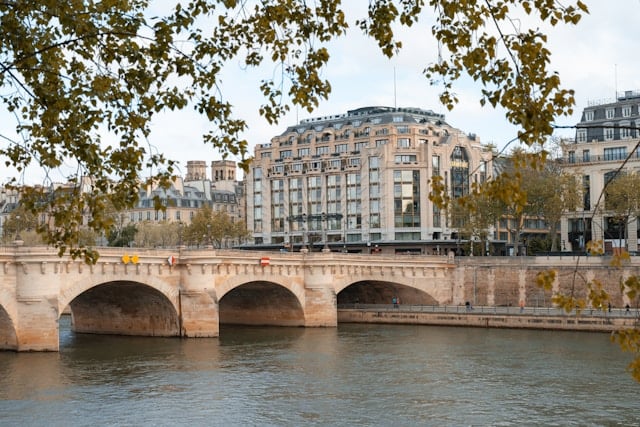
The Hotel Cheval Blanc overlooking the Pont Neuf and the Seine River.
Chef-Driven Discoveries: Starred Restaurants in the 5th Arrondissement
The streets immediately south of Notre-Dame — the medieval grid between the quais and the rue des Écoles — contain a concentration of independently run, chef-owned starred restaurants that most visitors never discover. These are not tourist restaurants that happen to have earned a star; they are serious culinary projects that happen to be located near the most visited monument in France.
AT — Atsushi Tanaka
4 rue du Cardinal Lemoine, 5th arrondissement — One Michelin Star
AT occupies a small, minimalist space on a street that leads directly down to the Seine, a five-minute walk from Notre-Dame's main portal. Chef Atsushi Tanaka trained with Pierre Gagnaire before spending formative years at Geranium (Copenhagen) and Frantzén (Stockholm), and the influence shows in a cuisine that crosses French classicism with New Nordic precision. His signature dish, "Camouflage" — arctic char concealed beneath a sculptural tangle of parsley and juniper — is as technically accomplished as anything you will find in Paris's more celebrated addresses. The chef personally designed much of the ceramic tableware. Budget approximately €100–€130 for the tasting menu. Book three to five weeks ahead.
Sola
12 rue de l'Hôtel-Colbert, 5th arrondissement — One Michelin Star
Chef Kosuke Nabeta's restaurant occupies a vaulted ground floor on one of the quartier's most atmospheric medieval streets, three minutes on foot from the cathedral's south portal. His tasting menu is a meditation on French-Japanese technique: local ingredients fermented, smoked, or dried using sake and ponzu, then framed in a classical French structure. The natural wine list is unusually considered (over 500 references including a serious sake cellar), and the handmade ceramics — most crafted by the chef himself — place this firmly in the category of total culinary experience. Expect €120–€150 for the menu. Reserve four to six weeks ahead; Sola is fully booked most evenings.
The side streets south of Notre-Dame retain a medieval scale that makes the restaurant discoveries feel proportionally private. Rue de l'Hôtel-Colbert, where Sola is located, is one of the most unchanged streets in central Paris.
Baieta
5 rue de Pontoise, 5th arrondissement — One Michelin Star
Chef Julia Sedefdjian became, at 22, the youngest female chef in France to earn a Michelin star — a fact worth stating once, then setting aside, because Baieta earns its place on any serious list on the quality of the food alone. Her cuisine is rooted in the Mediterranean, particularly the Nice of her upbringing: fresh, bold, herb-driven, with a generous use of olive oil and a technical precision that belongs to a much older culinary intelligence. Baieta means "kiss" in the Niçois dialect — an appropriate name for food that is affectionate without being soft. Dinner menus run approximately €60–€90. Book two to three weeks in advance.
Le Sergent Recruteur
41 rue Saint-Louis en l'Île, Île Saint-Louis — One Michelin Star
The one address on Île Saint-Louis that rises above the island's otherwise undistinguished restaurant scene. Chef Alain Pégouret — a former chef at Laurent, where he worked for eighteen years, and a product of Joël Robuchon's kitchen — transformed what was a medieval-themed tourist bistro into one of the most considered fine dining restaurants in the city. His technique is classical and immaculate: the Périgueux sauce alongside egg and black truffle mousseline is a master class in the French sauce tradition. The private dining room in the vaulted cellar seats twelve and can be reserved for exclusive dinners — a useful detail for clients bringing a group. Lunch menus from €39 (starter and main); five-course tasting menu at €98. Closed Sunday and Monday.

Notre-Dame from the 5th Arrondissement (South Bank).
Classic French Bistros: The Soul of the Quarter
Not every meal near Notre-Dame needs to be a gastronomic event. The 5th arrondissement and the adjacent Saint-Germain neighborhood contain some of the city's most honest bistros — places where the cuisine is classical, the welcome genuine, and where you will not find a single dish described with the word "artisanal" on the menu.
Atelier Maître Albert
1 rue Maître Albert, 5th arrondissement — Guy Savoy restaurant
Of all the restaurants in the immediate vicinity of the cathedral, Atelier Maître Albert occupies the most extraordinary room: the ground floor of a building that dates to the fifteenth century, with stone walls a meter thick and, in winter, a working fireplace wide enough to roast an ox. The menu is built around the rotisserie — poulet fermier, pigeon, Charolais beef, served with the kitchen's exceptional gratin dauphinois enriched with cream and garlic. Guy Savoy oversees the concept; the execution is consistent and generous. The three-course lunch menu at approximately €42 is one of the best-value midday meals in the neighborhood. Crucially, Atelier Maître Albert is open seven days a week — rare in Paris and particularly valuable on Sundays, when many of the starred restaurants are closed.
The dining room at Atelier Maître Albert occupies a 15th-century building directly across from Notre-Dame. In winter, the fireplace is lit and the rotisserie turns in full view of the room.
Allard
41 rue Saint-André-des-Arts, 6th arrondissement — Alain Ducasse group
Founded in 1931 and now part of the Alain Ducasse group, Allard represents a particular type of Parisian bistro that has largely disappeared: the kind where the dish list reads like a canon of French country cooking — boeuf bourguignon, grenouilles à la crème, tarte aux pommes — and where nothing on the plate tries to surprise you. Chef Lisa Desforges runs the kitchen with a directness that the room's worn zinc bar and dark wood boiserie seem to require. The lunch prix-fixe is around €35–€45. Allard fills quickly at both lunch and dinner; book at least a week ahead. A fifteen-minute walk west of Notre-Dame, via the Pont Saint-Michel.
Le Procope
13 rue de l'Ancienne Comédie, 6th arrondissement
Opened in 1686, Le Procope is the oldest continuously operating café in Paris and a Monument Historique. Voltaire, Rousseau, Benjamin Franklin, and Napoleon Bonaparte were regulars — a fact the room's portraits and vitrines make abundantly clear. The food is unapologetically classic brasserie: coq au vin, blanquette de veau, profiteroles. It is not the most refined kitchen in the neighborhood, but the combination of historical atmosphere and honest French cuisine makes it a defensible choice for a long lunch, particularly for visitors who want the experience of dining in a room where two centuries of Parisian intellectual life played out. Mains range from €20–€35. No reservation required for most service times, though weekends can fill up.
Le Procope opened in 1686 and has been classified as a Monument Historique. It is one of the rare restaurants in Paris where the building itself is as much the point as the food.
Dining on the Islands: Île de la Cité & Île Saint-Louis
Eating directly on the islands requires different expectations. The Île de la Cité has almost no independent restaurant life — its streets are given over almost entirely to law courts, police headquarters, and the cathedral itself. The exception is the western tip of the island, around the Place Dauphine. Île Saint-Louis is residential and more generously stocked, though the overall quality tends toward charming rather than exceptional.
Place Dauphine
Place Dauphine is one of the most beautiful and least-visited squares in Paris: a triangular, tree-shaded courtyard of seventeenth-century townhouses at the tip of Île de la Cité, facing the Pont Neuf. Two restaurants on the square are worth knowing.
La Rose de France (24 Place Dauphine) offers traditional French cooking in a room that looks directly onto the square's linden trees. The magret de canard and the crème brûlée are consistent; the terrace in summer is incomparable. Mains approximately €22–€32.
Le Caveau du Palais (17 Place Dauphine) is favored by the magistrates and lawyers from the adjacent Palais de Justice — always a reliable signal about a Paris bistro's credibility. The cooking is solid and traditional; the wine list is better than you would expect. Mains approximately €24–€38.
Île Saint-Louis
Beyond Le Sergent Recruteur, the island's main street (Rue Saint-Louis en l'Île) and quais offer several addresses worth a meal without requiring a reservation weeks in advance.
La Brasserie de l'Île Saint-Louis (55 Quai de Bourbon) has been operating since 1953 and remains the island's most authentic brasserie. The choucroute garnie, cassoulet, and jarret de porc have been on the menu since the early decades; the view from the terrace across the Seine toward the Right Bank is quietly spectacular. Mains €25–€40.
L'Îlot Vache (Rue Saint-Louis en l'Île) is a more intimate option: stone walls, attentive service, and a classic French menu with well-executed fundamentals — gratin dauphinois, duck breast with seasonal vegetables, a homemade tarte Tatin that earns its place. Reserve ahead for evenings.
Place Dauphine — one of the six royal squares of Paris, built under Henri IV in 1607 — is three minutes from Notre-Dame's west portal and almost entirely unknown to casual visitors.
Berthillon
29–31 Rue Saint-Louis en l'Île, Île Saint-Louis — Ice cream & sorbets
No visit to Île Saint-Louis is complete without acknowledging Berthillon, the family glacier that has been making glaces and sorbets from natural ingredients on the island since 1954. The cassis sorbet, the marrons glacés, and the seasonal flavors — fraise de bois in spring, châtaigne in autumn — are genuinely exceptional. In my experience taking clients through the Île de la Cité, an ice cream cone from Berthillon is one of those simple pleasures that lands at the right moment, particularly after two hours in the cathedral. Note that Berthillon closes during school holidays in July and August and on Mondays and Tuesdays year-round — a scheduling detail that catches many visitors off guard.
Quick & Gourmet: Coffee and Snacks Between Sights
Not every stop needs to be a sit-down meal. The neighborhood has seen a quiet influx of quality coffee and artisanal food shops in recent years — a shift that accelerated after Notre-Dame's reopening brought new foot traffic.
Café Chanceux (Rue Galande, 5th arr.) is the most interesting new arrival: an artisanal coffee and gourmet sandwich shop where focaccia and pastrami are made in-house and the chicken schnitzel sandwich has already attracted a loyal following among residents and a growing number of well-informed visitors. It is unpretentious, fast, and genuinely good — a useful option if your morning tour runs long and you need something substantive before a museum.
For pastry, the boulangeries immediately around the Place Maubert and rue Monge stock the best morning supply within walking distance of the cathedral. In my experience, the croissants and pains au chocolat from the independent bakers on these streets are significantly better than anything sold in the Île de la Cité itself, where most food retail is oriented toward tourist volume rather than quality.
Practical Guide: Crowds, Timing & Reservations
A few operational realities that will materially affect the quality of any meal near Notre-Dame:
When to Eat
Peak tourist concentration around the cathedral runs roughly from 10 AM to 6 PM. The restaurants immediately adjacent to the parvis fill fastest between 12 PM and 2 PM, particularly on weekends. If your itinerary places Notre-Dame in the morning, plan lunch in the Latin Quarter rather than on the island — you will eat better and with less competition for tables. Conversely, dinner in this neighborhood tends to be calmer than lunch; the majority of day-trippers have moved on by 6 PM.
Sunday Dining
This is one of the most important practical considerations in this neighborhood. A significant proportion of independent restaurants in Paris close on Sunday, and the 5th arrondissement is no exception. If your cathedral visit falls on a Sunday, your reliable options are: Atelier Maître Albert (open seven days), Le Procope, La Brasserie de l'Île Saint-Louis, and the Place Dauphine bistros. Confirm opening hours directly before the visit, as they can change seasonally.
Reservation Strategy
For the starred restaurants (AT, Sola, Baieta, Le Sergent Recruteur), book three to five weeks ahead for weekday lunches and four to six weeks ahead for weekend dinners. La Tour d'Argent and Guy Savoy require two to four months' advance planning if you want a specific date and table position. All of these restaurants take online reservations through their official websites or via TheFork (LaFourchette) for most; a confirmation call 48 hours prior is advisable for the more formal addresses. For bistros (Atelier Maître Albert, Allard, Le Procope), one to two weeks is generally sufficient.
Dress Code
La Tour d'Argent, Guy Savoy, and Plénitude maintain a tenue correcte exigée standard: jacket required for men, formal dress expected. The chef-driven starred restaurants (AT, Sola, Baieta) are relaxed in dress but not in standards; a jacket is appropriate but not mandatory. Bistros have no dress expectations beyond basic propriety.
Frequently Asked Questions
- What is the best restaurant near Notre-Dame for a special occasion dinner?
- La Tour d'Argent is the most iconic choice: one Michelin star, a direct view of Notre-Dame's apse from the sixth floor, and a theatrical pressed duck service that has been a Paris ritual since the 1890s. Book the window table two to four months ahead and request it explicitly. If the budget is truly open, Plénitude at Cheval Blanc (Three Stars) is the greatest dinner in the neighborhood's broader radius.
- Are there good restaurants actually on the islands, without crossing to the Left Bank?
- Yes, though options are limited compared to the Left Bank. Le Sergent Recruteur on Île Saint-Louis is the only Michelin-starred restaurant directly on the islands and worth the detour for dinner. For simpler meals, La Brasserie de l'Île Saint-Louis, La Rose de France on Place Dauphine, and L'Îlot Vache are all honest choices. Avoid the tourist-facing crêperies on the main tourist circuits unless you have done specific research on current quality.
- Is it hard to find good food near Notre-Dame, or is the area mostly tourist traps?
- The reputation for tourist traps is partly earned and partly outdated. The streets immediately on the north and east sides of the cathedral (particularly the streets running toward Saint-Michel) do concentrate mediocre restaurants with laminated menus and street touts. But the Left Bank streets south of the cathedral — between the quais and the rue des Écoles — contain one of the highest densities of Michelin-recommended restaurants in the city. The rule is simple: avoid any restaurant where the menu is displayed in six languages with photographs.
- What should I eat near Notre-Dame that is authentically Parisian?
- The neighborhood lends itself to two authentic categories. For a classic bistro lunch: oeuf mayonnaise, steak-frites or entrecôte, a carafe of house Burgundy, and tarte au citron to finish — this is what Parisians eat, and Atelier Maître Albert or Allard deliver it well. For a more ambitious meal, the Île de la Cité's proximity to the Seine and its history as the original heart of the city makes it appropriate to end with Berthillon ice cream on the Île Saint-Louis — a ritual that needs no further justification.
- When is the best time of day to visit Notre-Dame and then eat lunch?
- I consistently advise clients to arrive at Notre-Dame at 9 AM when it opens — the morning light through the rose windows is unmatched and the queues are minimal. A guided visit runs roughly 90 minutes, which places lunch around 11:30 AM to 12 PM. This is slightly early for French lunch service (most restaurants seat from noon), but it means you are ahead of the midday crush. Atelier Maître Albert, which opens for lunch at noon, is ideally positioned and booked for this slot.
- Are any restaurants near Notre-Dame open on Sundays?
- Yes, but fewer than most visitors expect. Reliable Sunday options include Atelier Maître Albert (open every day), La Brasserie de l'Île Saint-Louis, Le Procope, and the Place Dauphine bistros. The Michelin-starred chef-driven restaurants (AT, Sola, Baieta) are generally closed Sunday; La Tour d'Argent is also closed Sunday and Monday. Always verify current hours directly with the restaurant before visiting.
- How much should I budget for dinner near Notre-Dame?
- The range is wide. A bistro dinner at Atelier Maître Albert or Allard runs €50–€80 per person with a half-bottle of wine. The chef-driven starred restaurants (AT, Sola, Baieta, Le Sergent Recruteur) are €90–€160 with beverage pairing. La Tour d'Argent dinner starts at approximately €250–€300 per person. Guy Savoy and Plénitude are €350–€500 with full wine pairing. None of these include the premium for great window or terrace tables, which generally requires booking early rather than paying more.
Conclusion
Notre-Dame's reopening in December 2024 did not create this neighborhood's dining scene — it revealed it to a new generation of visitors who had been steered elsewhere. The streets south of the cathedral have been home to some of Paris's most serious cooking for years, largely under the radar of the major tourist circuits. The challenge, as with any densely visited neighborhood, is knowing where to look.
The selection above is the one I would give to any client arriving in Paris for a private tour: specific, honest, and organized around the realities of visiting one of the world's most extraordinary monuments. A meal at La Tour d'Argent following a morning in the cathedral, or a quiet dinner at Sola after the crowds have thinned — these are the kinds of experiences that justify the phrase art de vivre.
If you are planning a private guided visit to Notre-Dame and want to build an itinerary that integrates the cathedral experience with the best of this neighborhood — including access strategies, timing, and what a knowledgeable guide actually changes about the visit — you will find the details on my Notre-Dame Cathedral private tour page.

Notre-Dame Cathedral Paris.
References
- Guide Michelin France 2025 — Tour d'Argent, AT, Sola, Baieta, Le Sergent Recruteur, Guy Savoy, Plénitude entries. guide.michelin.com
- Michelin Guide editorial — "Where to Dine Near Notre-Dame: 12 Must-Try Paris Restaurants." Published July 2025. guide.michelin.com
- Michelin Guide editorial — "Where to Eat, Sleep and Explore Around Notre-Dame in Paris." Published December 2024. guide.michelin.com
- La Tour d'Argent — official website. tourdargent.com
- Restaurant Le Sergent Recruteur — Michelin Guide entry. guide.michelin.com
- Notre-Dame de Paris — official site, reopening information. notredamedeparis.fr
- Sortiraparis — "Restaurants near Notre-Dame, Île de la Cité and Île Saint-Louis." Updated October 2025. sortiraparis.com
- Berthillon — official website. berthillon.fr